3.5
/5
TCP Score
👍 Recommended
The Devil Wears Prada 2 story:
After a downturn in her successful career in hard journalism, Andy Sachs (Anne Hathaway), in the 2026 sequel, takes a job as features editor at Runway magazine. The iconic Miranda Priestly (Meryl Streep) is dealing with a public relations issue stemming from a contentious fast-fashion collaboration while also attempting to preserve her hegemony in a media environment riven by digital sensationalism and a shift away from conventional print. Emily Charlton (Emily Blunt) has ascended to the position of powerful executive at a high-end fashion conglomerate, and her advertising budget is now the sole source of revenue for Runway, completely altering the power dynamics.
The trio is thrown back into a collaborative effort and is now faced with the daunting task of navigating the modern influencer and corporate takeover market. Their goal is to determine whether there is still room for quality in this age of quick trends.
The Devil Wears Prada 2 review:
Towards the end of The Devil Wears Prada 2, Meryl Streep's Miranda Priestly gives a satisfactory smile with tears in her eyes and says, "I love working! Don't you love working?" It's such a poignant moment where it felt like the lines between the real and the reel were blurred; you could feel the actor still being on her toes to work. It also serves as a reminder to people who, like her, are pursuing their passions with the hope that they never die. In the 2006 original film, Priestly proudly asserts that no one can do what she does and that no one understands Runway better than she does. With that attitude, she struts forward two decades later. Her face shows signs of tiredness, which is not due to her continued existence in the Runway universe but rather because she is gradually becoming a corporate slave—a stark reversal of her earlier position.
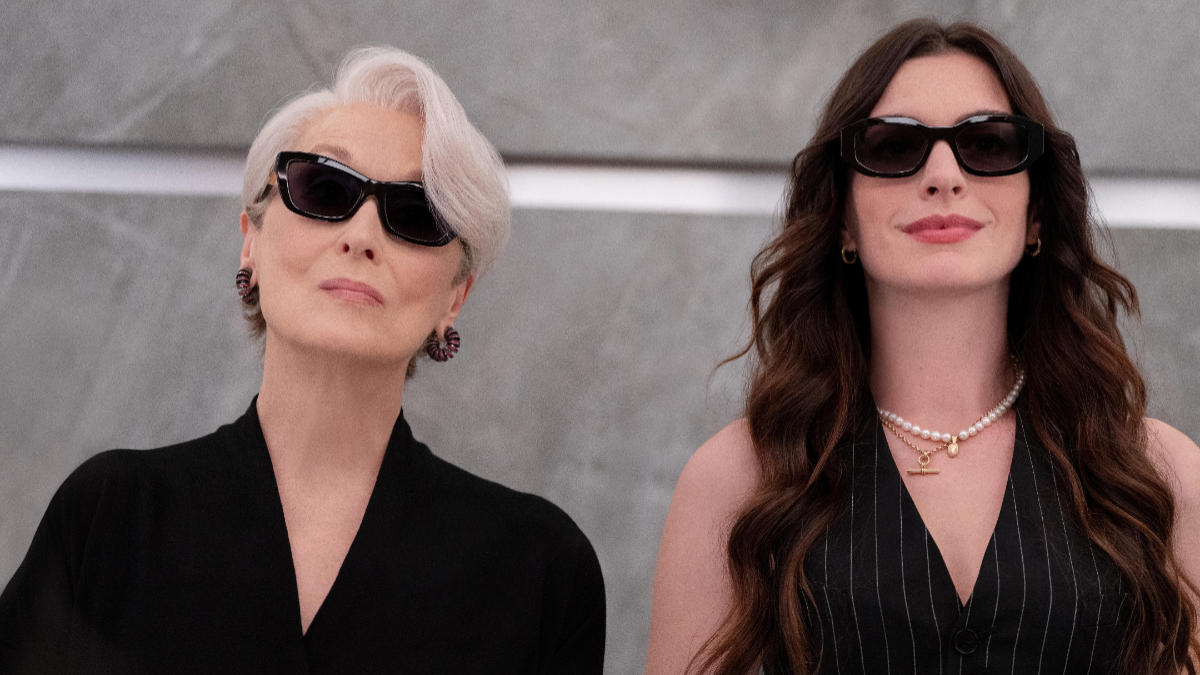 Meryl Streep and Anne Hathaway in The Devil Wears Prada 2
After a very long time, a film felt so personal to me, and I am super glad that it's The Devil Wears Prada 2. The original film has been like comfort food for me, and I could just replay the whole thing in my mind without skipping any parts. But coming to the sequel, I am still grappling over the fact that they decided to show the horrors faced by journalists in today's times. We live in a digital age where everything is being slowly taken over by AI, leading to concerns about the diminishing role of human creativity and empathy in journalism and storytelling. When Miranda learns about the situation, she tears up, and you can instantly sense the impact of her emotions—a bridge between the high-standard perfectionism of the past and the soullessness of the present.
How will we manage non-humans, whom humans themselves prioritise significantly? The film begins on a serious note with Andy Sachs (Anne Hathaway) at an awards event, where, just as she is about to be honoured, she receives a text message saying that she and her whole editorial team have been sacked. Her initial excitement about winning an award quickly turns into disappointment. Where's the safety net for writers in today's times?
However, she is a lucky one to get hired as the features editor at Runway, going back to the place where she was a second assistant to Miranda Priestly about two decades ago. After tossing her phone in Paris, she went on to become an award-winning investigative news journalist, travelling around and breaking news that actually had an impact. Now back at Runway, which she previously viewed as a stepping stone in her career, she finds it has become a place where she can finally write whatever she wants.
But with the freedom to write comes the significant question of metrics—are people even reading your piece? Writers are often asked whether their story is ranking on Google or "going viral" instead of being acknowledged for the quality of their work.
In The Devil Wears Prada 2, Andy reunites with Miranda after a long time, but the latter fails to recognise her. This lack of recognition is not surprising; Miranda is now navigating a corporate fog where she is no longer the centre of a universe that bends to her will. In no time, Andy discovers that while people used to "gird their loins" on Miranda's arrival, things have changed extremely at Runway. There is a scene in which Miranda hangs her coat and places her purse on the table, whereas earlier she had just thrown them randomly. HR policies, particularly for bosses, establish strict ground rules in our current era.
Well, that doesn't mean she doesn't have any assistants. Amari (Simone Ashley) is a superefficient assistant who also makes sure to keep Miranda in check, correcting her if she says any "politically" incorrect statements. Thus, Miranda has definitely lost the absolute freedom with which she once ran Runway. Streep brings her unique quirks to the role, making it difficult to imagine anyone else portraying the character as seamlessly as she does.
Then there's Nigel (Stanley Tucci), who still has the best lines and delivers them flawlessly, making him an instant fan favourite once again. His character development resembles that of a person who remains at a company for an extended period, regardless of personal growth or financial gain.
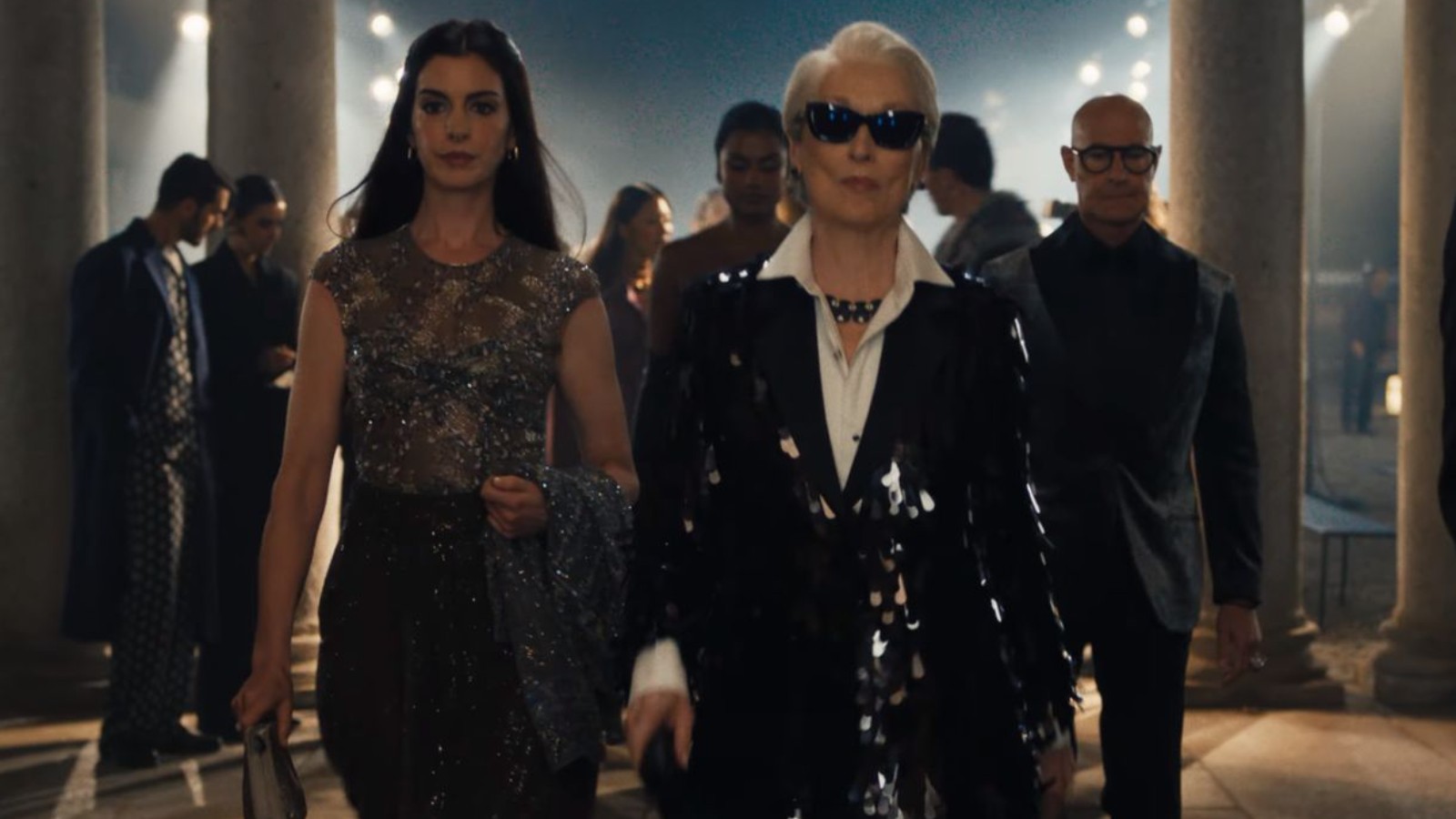
The Devil Wears Prada 2 has a lot of fashion going on, with every couture item coming in, and of course, the film moves to Milan, Italy, for Fashion Week, where a tsunami of outfits barges into every frame. The looks are palpable and the atmosphere is immersive, but this time, writer Aline Brosh McKenna and director David Frankel make it more of a social commentary on the challenges faced by writers in the fashion industry and the broader implications of creativity in a commercialised world.
Probably, common people might not understand the plight of writing being a dying art. But here I am, being an insider of this journalistic world; it hits home deeply and speaks to you about how thriving doesn't always equal surviving. One day your presence is acknowledged, and in the next moment, you are stranded and might not be picked up even as soon as you expect.
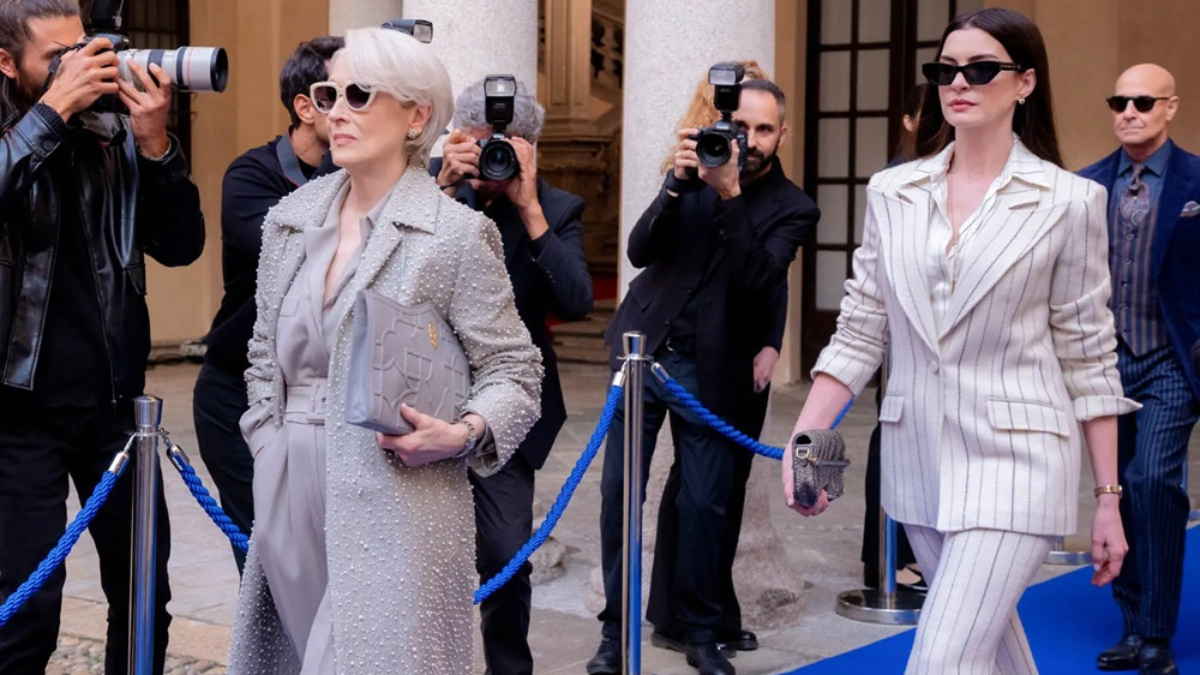
Meryl Streep and Anne Hathaway
Even here, the arc of Emily Charlton (Emily Blunt) gets a certain depth. In the first film, you would look at her and believe that she is on the path well-established by Miranda and might reach that stature as well. However, you have to carve your own path even without your will, because survival is more important than looking forward to living the long, "unfulfilled" dream.
Andy, this time, despite being uplifted in her career, gets stuck in the loop amid clackers, where she still hopes to get validation from Miranda. Well, I can't blame her for feeling this way, even after two decades. However superficial I felt of her character this time, it totally felt like she was not the one taking the story ahead. Hathaway makes it charming as always, and the character of Andy comes very naturally to her. Even though the character physically doesn't have to do heavy lifting, there's the actor who just pushes it emotionally, bringing the vulnerability and restlessness that many standing in her character's situation would.
Who am I to talk about Streep, the actor who has reached a stage that can just be awed and studied thoroughly? The balance of sarcasm or overly emotional responses that the actor brings make her character more humane and understandable. At one point, I felt like Streep was giving a voiceover to my current state of mind.
The Devil Wears Prada 2 includes all the elements of spice and sass, but the bittersweet nature of modern journalism is the key takeaway from the film.
The Devil Wears Prada 2 verdict:
Sharp, stylish, and unexpectedly soulful, The Devil Wears Prada 2 trades clackers for corporate metrics. Meryl Streep delivers a masterclass in vulnerability, while the story offers a biting yet empathetic look at journalism's digital decline. It's a rare sequel that captures the original's magic while confronting a harsher modern reality.